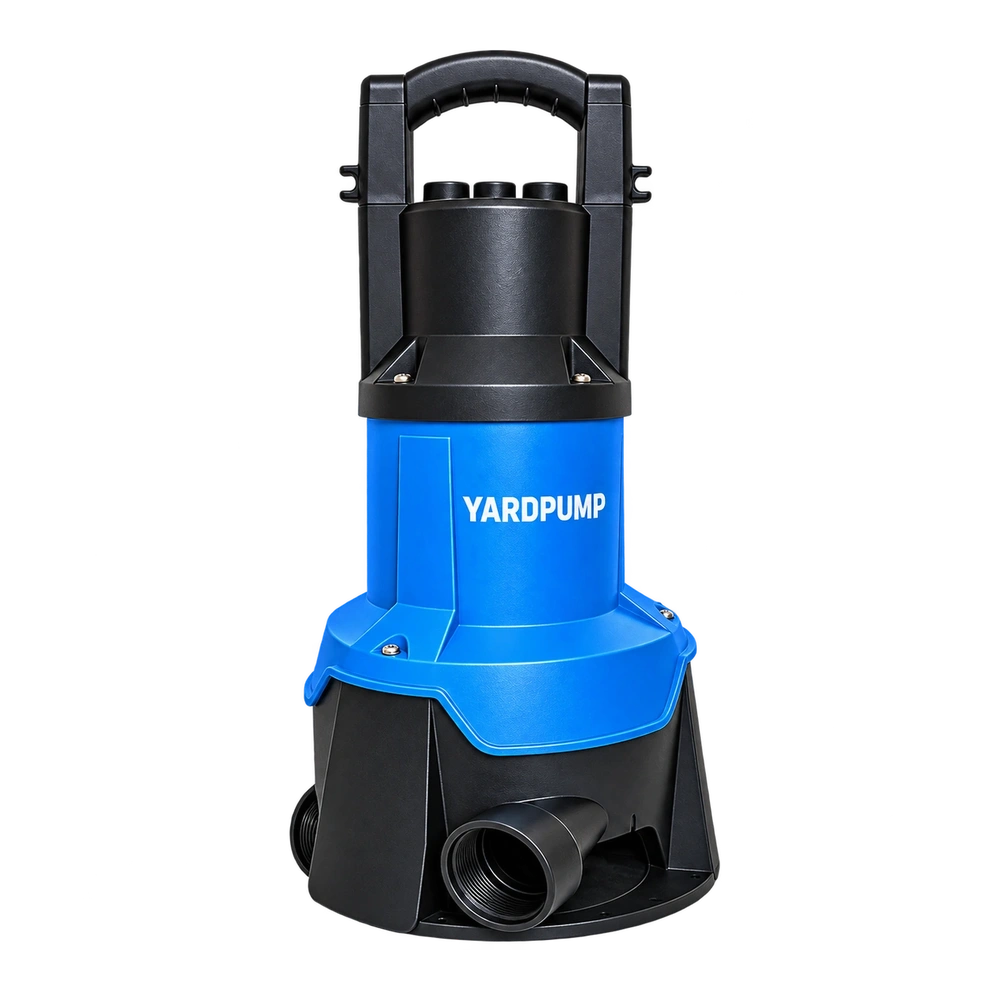
A dealer has sold a manual low-level pump for the final pass over wet floors. On the next reorder, the stock system suggests substituting an automatic unit with the same stated residual depth and combining their stock codes. Can it do that? Find out whether customers need to start in shallow water, restart unattended as water returns, or draw down close to the floor once flow is established. Each is a different condition. If the proposed unit cannot do the original job, it is not an unconditional replacement.
Record how the original unit entered service
The depth needed to start the first pumping run is an intake and installation condition. A manual control does not authorize starting in an arbitrarily thin film. Automatic models also need a start signal from their float or sensor. Some controllers handle an initial fill, power restoration and subsequent cycles differently. A published residual depth describes the end of a successful drawdown under its test conditions. It does not tell you whether the pump will start again when water returns to that depth.
Ask the customer for the old order or label, depth at first startup, whether anyone supervises it, whether inflow continues after shutdown, the behaviour expected after a power cut, and the actual hose route. Compare those states with the instructions and supporting tests for both configurations. It is possible to find different controls in related cases or products; use the exact variant. For example, the verified QDX-PT configuration is a manual clean-water pump. Its published residual-water figure does not establish the behaviour of an automatic variant. The model family or appearance cannot settle that difference.
Test the substitution in both directions
For illustration, suppose two units draw down to about 8 mm once flow is established under the stated test conditions. Customer A starts on a hard floor with 25 mm of water and operates the pump as the manual permits. If the automatic unit does not call for a start until 70 mm, it will not even begin that job. Customer B needs the pump to start unattended after a normal water level is reached. Sending a manual unit into that application is not an equivalent substitution either. The 8, 25 and 70 mm figures are hypothetical. Check actual model requirements, operating conditions and control behaviour. A third customer may care mainly about prompt removal of repeated inflow; their decision may not depend on the final few millimetres at all.
Translate the decision into a stock rule
Set separate statuses for equivalent replacements, conditional substitutions and applications that require the original control type. State the condition the customer must satisfy for a conditional replacement. For example, a proposed new collection point may provide a permitted start depth, but also needs the right control and route. If you cannot establish the previous use, hold the substitution rather than making the new unit the default. Reserve original stock according to active installations, unresolved service commitments and reorder lead time. A fixed percentage is less useful than those actual obligations.
Attach the replacement rationale to the original unit identifier and service ticket. Check the label and included operating instructions for the version that leaves the warehouse. A correct label matters when two similar products respond differently after a floor cleanup or a power cut. For the next range review, compare low-level utility pumps by start, stop and restart behaviour as well as the published residual figure.
Keep the lookup keyed to the product code on the customer’s unit. Label the replacement instructions with the tested control combination. A change of packaging or colour can then be handled without accidentally changing the control mode used for an installed job.
Frequently asked questions
If an automatic model has a manual mode, will it replace any manual unit?
Check the allowed initial depth, stop behaviour, cooling conditions and power restoration in that mode. A switch label does not establish an equivalent sequence.
Do I need to keep a whole pallet of the older model?
The decision depends on active installations, service demand and available supply. Define jobs that cannot use the substitute before choosing how many replacements to hold.
The customer remembers only that it pumped almost dry. What should I ask?
Ask how the old pump started and how deep the water was at that point. Ask whether water comes back after it stops and whether the next start must occur unattended.