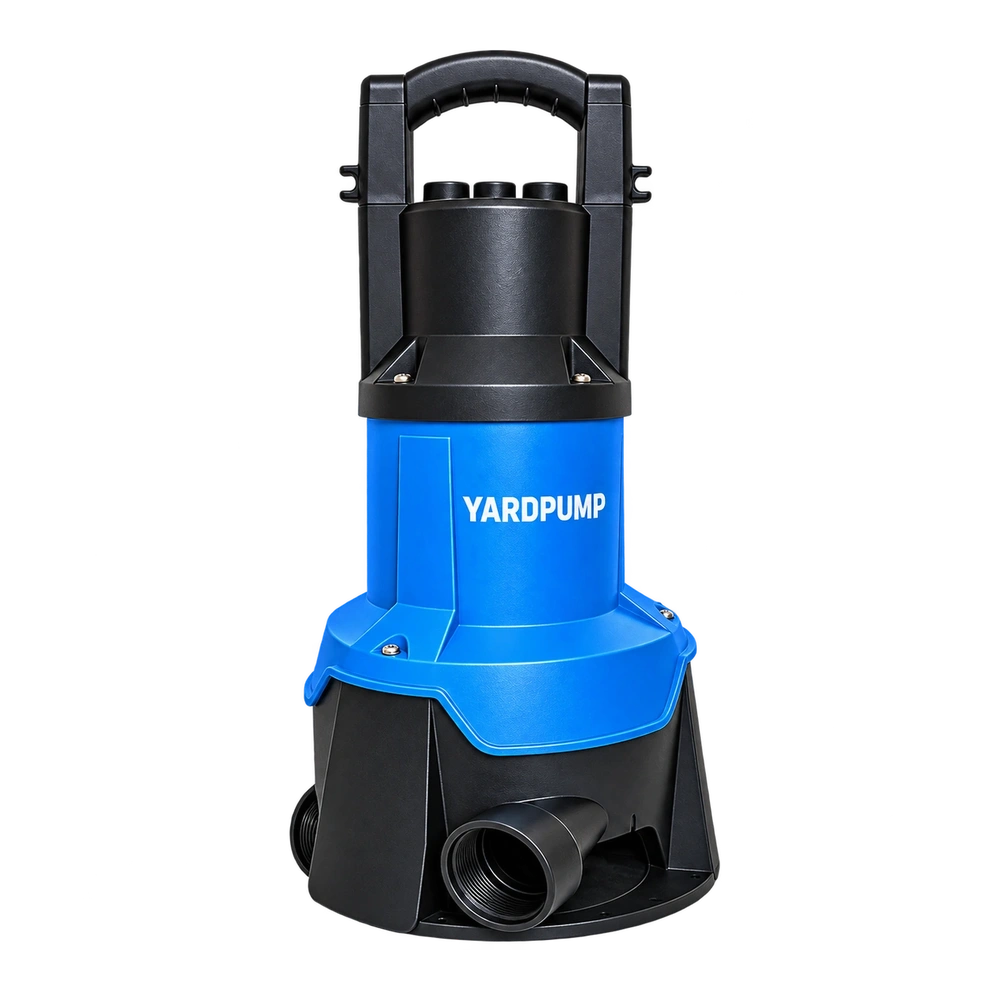
The drainage pump still moves water, but a bulge has appeared halfway along the discharge hose while the adjacent sections look unchanged. That is different from a layflat hose opening across its length as it fills. Local swelling can indicate damage to reinforcement or separation between layers. Do not keep the damaged hose in service to test pump pressure. Stop using it, record where it happened, and put in a suitable replacement assembly before investigating causes that could damage another hose.
Stop the pump before investigating the deformation
In a reinforced hose, the inner tube carries water, the reinforcement limits expansion, and the cover protects the hose from abrasion and weather. Operating pressure can enlarge a weakened spot. There could also be layer separation, crushing, wear or heat damage. A photo of the outside does not establish which mechanism came first or prove that the pump exceeded the pressure rating.
If the swelling is localized, stop and isolate the pump from a safe, dry position and prevent restart. Have qualified staff manage any retained pressure and water as directed before handling the hose. Do not press, puncture or tape the swollen spot, or pressurize it again for a photo. Have personnel address electrical and drainage risks if the area is flooded. A bulge shrinking after shutdown does not restore the hose. A wrinkle in a loose protective sleeve can look different from swelling of a pressure-bearing part of the hose. If you cannot distinguish them, take the assembly out of service and have the supplier inspect it.
Keep hose damage and operating conditions as separate evidence
After safe isolation, photograph the feature in the context of the whole route. Record how far it is from the outlet fitting and whether it lies at a threshold, a sharp edge, a hot surface or a support. Take a closer photo showing the suspect area beside an undamaged section, with an appropriate scale and readable hose markings. If the damage is near a fitting, show the relation between the clamp, the solid fitting and the hose end. A rub mark, indentation or discoloration is a clue. Service needs to know whether it aligns with the bulge.
Separately record the hose part number and application, pump fittings, elevation change and outlet valve position. If reliable pressure records already exist, retain the data and operating conditions. Do not pressurize the damaged hose to obtain a peak. The complete hose assembly must be suitable for the conditions, including the hose and the fittings. Check for an outlet that can close abruptly or a route where the hose is repeatedly flattened. The pump label alone can neither exclude local damage nor prove a fault in the supplied hose.
Decide what to return and what to replace
In an illustrative case, a safe, depressurized section measures about 32 mm across, while an adjoining spot remains noticeably wider at about 42 mm. A scale photo shows the swollen area directly beside a threshold abrasion mark. These dimensions are an example, not a safety limit. Isolate that hose and inspect other lines installed in the same way. Have the installer check the route and threshold protection and ask the supplier whether the retained condition supports a local damage finding. If the same lot shows similar damage across different installations within their limits, keep the lot traceability and ask the supplier to investigate manufacture or material. In neither case do you need to cut up the hose onsite to prove the cause.
Use a complete replacement assembly suitable for the liquid, temperature, pressure, bend conditions and fittings. Correct any crushing, twisting and support problems. Observe the initial discharge and hoses from a safe position under the approved procedure. Matching color or diameter, or the fact that an undamaged hose still works, does not release the damaged one for use.
Frequently asked questions
What if the bulge only shows at startup?
Stop using the hose and give service the observation you already have. A bulge disappearing does not mean reinforcement has recovered. Do not pressurize it again to confirm.
Can I just buy a hose with a higher pressure rating?
First check the cause. Crushing at a threshold, bad bends, fittings or a prohibited closed outlet can still damage a replacement assembly.
Why does a bulge matter if flow still looks normal?
Normal flow means there is a passage for the water. It does not prove the swollen area can continue to hold pressure at later starts or stops.