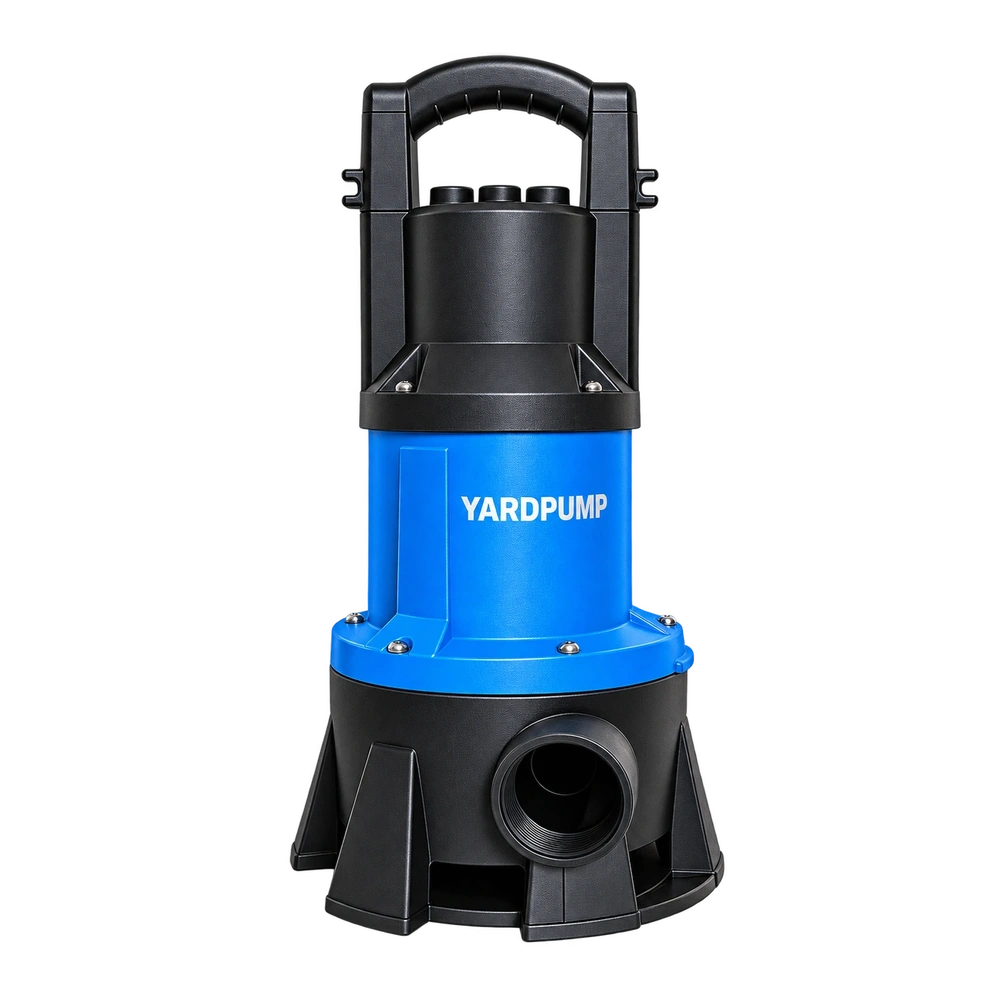
A familiar pump problem often starts with a simple observation: A compact submersible pump can empty a hot tub quickly, but its intake may sit against a curved shell, soft cover or drain fitting as the level falls.
The useful answer is not to choose a larger rating or accept a supplier's single measurement. Use a stable protective base or guarded intake, verify the water temperature and treatment chemistry, and plan the final residual-water stage separately. This keeps the decision tied to the actual liquid, installation, component revision and operating point.
The decision first
Use a stable protective base or guarded intake, verify the water temperature and treatment chemistry, and plan the final residual-water stage separately.
The first step is to freeze what is being compared. Record the pump model or component revision, liquid condition, supply, speed, installation and test method. If two samples are tested under different water levels, temperatures, hose layouts or electrical conditions, the result cannot isolate the feature named in this article.
For a service complaint, preserve photographs, labels, marks, deposits and measured values before cleaning or dismantling. For a purchase change, connect the drawing, BOM, supplier lot, sample and production cut-in. That evidence prevents a plausible explanation from becoming an unsupported conclusion.
Why the symptom can be misleading
As water depth falls, the intake velocity becomes concentrated near the surface and nearby walls. A flexible mat can seal against the screen, while a hard pump foot can scratch acrylic. Low-level pumps may leave less water but can also ingest settled grit. Warm chlorinated or brominated water needs material confirmation.
The observed symptom is therefore a system response. A dimension can influence hydraulics, mechanics and heat at the same time; a control component can change both operation and the evidence seen by a technician. The correct question is not whether one feature is “good” or “bad,” but what changes at the agreed duty and which limit becomes controlling.
A practical check plan
| Check | What to verify | 中文现场提示 |
|---|---|---|
| Water condition | Confirm temperature, sanitizer and sediment | 确认水温、消毒剂和沉积物 |
| Surface protection | Use a clean stable base that cannot block the intake | 使用不会封堵进口的清洁稳定底座 |
| Hose route | Prevent hose weight from dragging the pump | 防止软管重量拖动水泵 |
| Final stage | Set a stop level and residual-water method | 设定停泵水位和残水处理方法 |
Carry out the checks in a sequence that protects evidence. Begin with identity and external conditions, continue with non-destructive measurements, and dismantle only when the earlier results justify it. Use calibrated or otherwise controlled instruments appropriate to the decision. Record raw values as well as the final pass/fail judgment.
When several factors may be involved, change one controlled factor at a time. Keep an approved reference unit where possible. A matched comparison usually explains more than a single result against a broad catalogue tolerance.
Worked example
Example only: place the pump on a clean perforated platform that spreads load and keeps openings clear. Stop before the pump loses the required submergence, then remove the remaining water by the approved low-level method.
Write the example assumptions into the report. Show the starting condition, what was changed, and the measured response. If the result depends on an assumed dimension, water level, voltage or material condition, label it as an example rather than presenting it as a YARDPUMP model specification.
How to turn the result into a decision
For selection, confirm that the installed duty remains inside the pump and accessory limits, then document the setup the user must reproduce. For procurement, turn every critical finding into a drawing note, inspection characteristic, approved sample or change-control requirement. For after-sales work, distinguish a confirmed cause from a symptom and an untested possibility.
Acceptance should cover the complete assembly where the interaction occurs. A loose component may pass a dimensional check and still behave differently after clamping, immersion, heating or loading. Conversely, a failed assembly test does not automatically identify which component is defective; it tells the team where a controlled comparison is needed.
Boundaries and safety
Do not enter the tub while portable electrical equipment is connected. Isolate power before moving the pump, and follow the pump and spa manufacturer instructions.
Industry mechanisms in this article are not specifications for every YARDPUMP model. Use the latest approved drawing, datasheet, manual and compliance file for the exact model and revision. Stop any test that creates unsafe heat, leakage, unstable support or electrical exposure.
Frequently asked questions
Can I put an ordinary submersible pump on a soft liner?
Check both manuals for support requirements. Avoid sealing the inlet or dragging hard edges across the liner.
Does waiting for the water to cool help?
It can reduce temperature risk. You still need to check treatment chemicals and discharge conditions.
Can I keep the pump on for the last puddle?
Stop at the manufacturer's operating limit and remove the remaining water as the tub instructions allow.