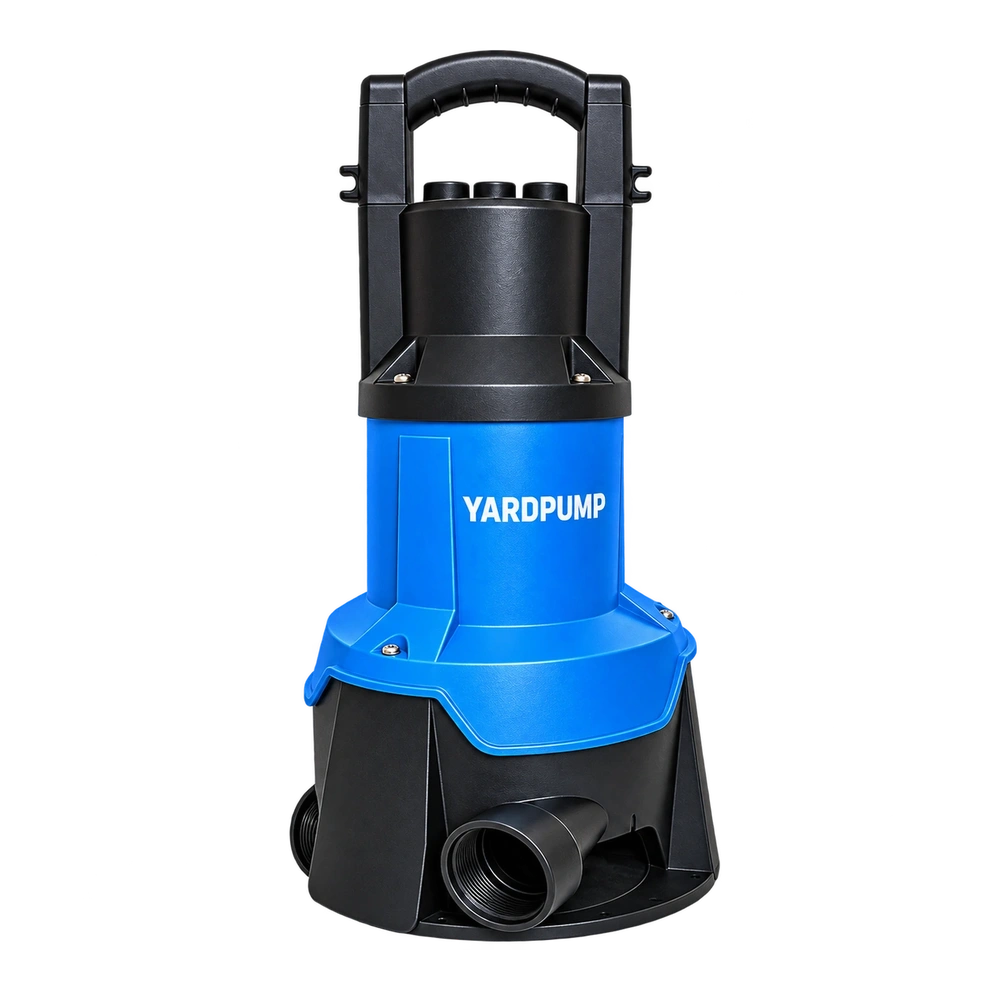
Suppose clear water has collected under a work platform. You want a portable low-level pump, but a crossbeam hangs lower than the deck. Measure from the working surface to the lowest obstruction. Compare that clearance with the highest point of the pump, outlet fitting and connected hose. How shallow the pump can drain and how tall the complete installation stands are different measurements. A pump that leaves very little water can still be too tall once you fit an upward adapter and route the hose. A side outlet may save space above it but need more room alongside the platform.
Measure from the surface where the pump will stand
Draw the access opening, crossbeam, wall and final pump position. Measure the headroom at the intended position and the height and width of the access opening. Do not use deck height as a substitute for crossbeam clearance. If there is a threshold or a sloping floor, carrying, turning and removing the pump can take more space than its stationary footprint. Use the model drawing to check the handle or approved lifting point, intake base, connections and cable exit. The hose and power cord are not handles. If the equipment cannot be placed and recovered safely, collect the water at an accessible low point or have a qualified installer assess another arrangement.
Use stable support consistent with the instructions. Do not wedge the pump at an angle or remove the base or a guard to save height. An automatic model also needs the specified travel or clearance for its float or sensor. Passing through an opening does not establish that the pump, cable or hose will clear the surroundings during operation. Record three separate clearances: access to the position, space in the working position and space to recover and clean the isolated pump. Once those work, compare flow and head for the job.
Sketch both the top and side discharge routes
Consider an illustrative clearance of 150 millimetres and a pump body 120 millimetres tall. A straight adapter adds 40 millimetres above the body, and routing the hose from the top of that adapter to horizontal needs about 55 millimetres more. If the three dimensions are stacked, the assembly reaches about 215 millimetres. It does not fit. An allowed side outlet arrangement could stay below 150 millimetres in height but still need a straight length and a bend alongside the pump. The 55 millimetres is space in the example drawing, not a minimum bend radius for any hose. Check the approved fitting and actual hose, including the highest point of the elbow or clamp.
A cardboard outline and the actual fitting are useful for a dry comparison. Then test the permitted arrangement while attended and following the instructions. A tight bend can flatten the hose, add loss or pull on a plastic outlet. Use the intended route and supports in the wet test. Look for changes in hose shape as it fills and check the delivery rate. A pump that can be squeezed into position can still drain too slowly because its hose is pinched.
Leave a way to stop and recover the pump
Arrange power and controls in safe, reachable locations. Confirm the starting water depth, permitted duty, automatic stop behaviour and maintenance access for the chosen model. Low-level pickup can remove shallow clean water near the intake. It does not establish permission for dry running or unattended use. If removing the unit requires disconnecting the hose, allow access to isolate power, confirm pressure has been relieved and then disconnect it. Have a qualified person assess spaces with electrical or entry hazards. Do not make connections in standing water or reposition energized equipment there.
For a quote or delivery check, send the headroom, a photo of the opening, the permitted hose route and expected head. Ask for the installed outline with the actual supplied adapter and confirm whether the job calls for a clean-water low-level pump, a clean-and-dirty-water model or another category. If the bare pump barely fits, resolve connection and service clearance before relying on a low residual depth figure.
Frequently asked questions
Does a low-level rating mean the pump has a short housing?
No. It describes drainage performance. Installed height depends on the housing and fitted connection.
Will a right-angle fitting always solve the height problem?
Check that the pump permits the fitting, that the bore suits the duty and that the hose is supported. The elbow can add loss or take space at the side.
Can I slide the running pump into its final position?
Confirm placement, hose routing and recovery while isolated. Do not move a powered pump or adjust its connection in unsafe wet conditions.