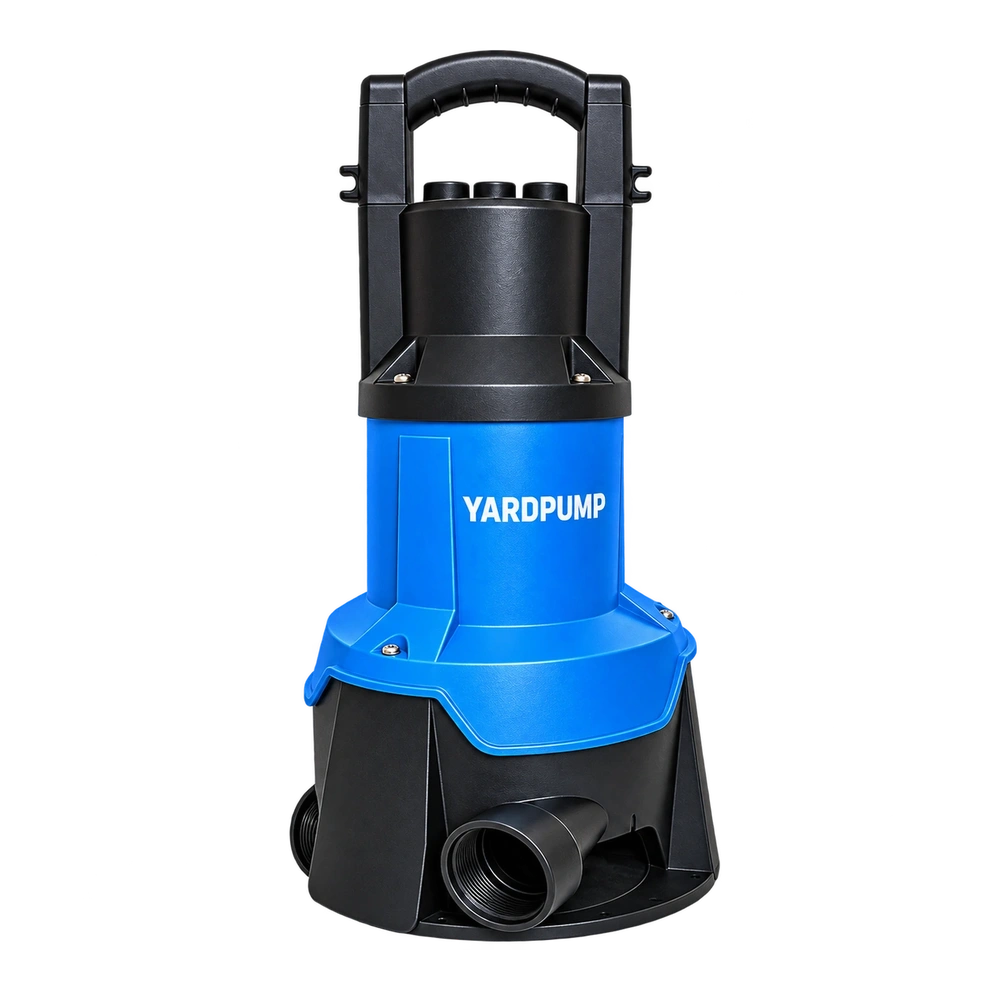
A plastic submersible pump appears to produce an impossible speed reading. Should the nameplate be changed, or are plastic pumps simply difficult to measure? The first question is more basic: what rotating signal did the instrument actually detect? An optical tachometer generally counts reflected events. It does not identify the motor shaft for the operator. A steady number can therefore be repeatable without representing the required mechanical speed.
Identify the rotating target first
An opaque housing prevents a direct optical view of the enclosed rotor. Pointing a light at that housing does not establish the speed inside it. Reflections from water, passing blades, another rotating accessory or the background can create an unrelated signal. The record must identify the measured component and its mechanical relationship to the motor shaft. A drive ratio, if present, also matters.
This is not a reason to remove guards or run a submersible pump dry to expose a convenient target. Cooling, hydraulic load and seal conditions remain part of the approved operating boundary. Competent personnel should arrange a suitable method in a controlled facility. If there is no safe, valid measurement position, change the measurement arrangement rather than improvise an exposed rotating test.
Count events per revolution
If the sensor receives f effective pulses each second and there are k pulses per revolution, rotational speed is 60f/k in revolutions per minute. An instrument configured for one event per revolution can overread when it detects two. Some instruments allow an event-count setting; others require the reflective marking arrangement described in their instructions. Neither arrangement should be assumed from the display alone.
Consider a hypothetical counting example. A sensor detects 95 pulses per second, with two effective marks per revolution. The corresponding speed is 2850 rpm. Calculating with one mark gives 5700 rpm. These are illustrative numbers, not a pump test result. Missed pulses, intermittent masking and reflections can also produce low or erratic readings. A suspicious number must not simply be divided by two without checking the signal.
| Check | Possible misleading result |
|---|---|
| Target and shaft relationship | Accessory speed mistaken for motor speed |
| Effective events per revolution | Pulse frequency converted with the wrong multiplier |
| Units and instrument mode | Revolutions per second or wheel conversion misread |
| Reflection and visibility | Extra counts, missed counts or unstable readings |
Use motor physics as a cross-check
With supply frequency, pole count and normal motoring operation established, synchronous speed provides a useful plausibility check. A two-pole induction motor supplied at 50 Hz has a synchronous speed of 3000 rpm, while loaded rotor speed is normally below it. That check cannot be transferred unchanged to a variable-frequency supply, another pole count or another motor type.
A plausibility check flags a contradiction; it does not authorize replacing a measurement with the number someone expected. Preserve the original result when the instrument, target and motor conditions disagree. Investigate the measurement chain and document the repeat test. A difference between 2830 and 2850 rpm also cannot, by itself, establish an efficiency or quality difference between two pumps.
Make the result reproducible
Ask for sample identity, instrument model and relevant calibration status, target component, measurement mode and effective mark count. Record voltage, frequency, water temperature and the associated flow and head. Identify whether the number came from loaded operation, a dismantled motor test or a software calculation. Results with different boundaries should not be compared as though they describe the same condition.
For a disputed result, a clear explanation of the original signal is more useful than a request to fill in a familiar rpm value. Where suitable facilities permit, a second independent method can help resolve the disagreement. Speed is one part of the load picture: it does not replace input-power, torque or efficiency measurements. Establishing what was counted makes the rest of the test discussion meaningful.
Questions about speed measurements
Does a plastic housing make every tachometer inaccurate?
No. Accuracy depends on obtaining a valid rotational signal under conditions suitable for both the instrument and the pump.
Is a stable display proof of a correct measurement?
No. A consistent extra reflection or an incorrect event-count setting can produce a stable but incorrect result.
Can shaft power be calculated from speed alone?
No. A direct mechanical-power calculation also needs torque. Speed alone cannot supply an unknown efficiency or output power.