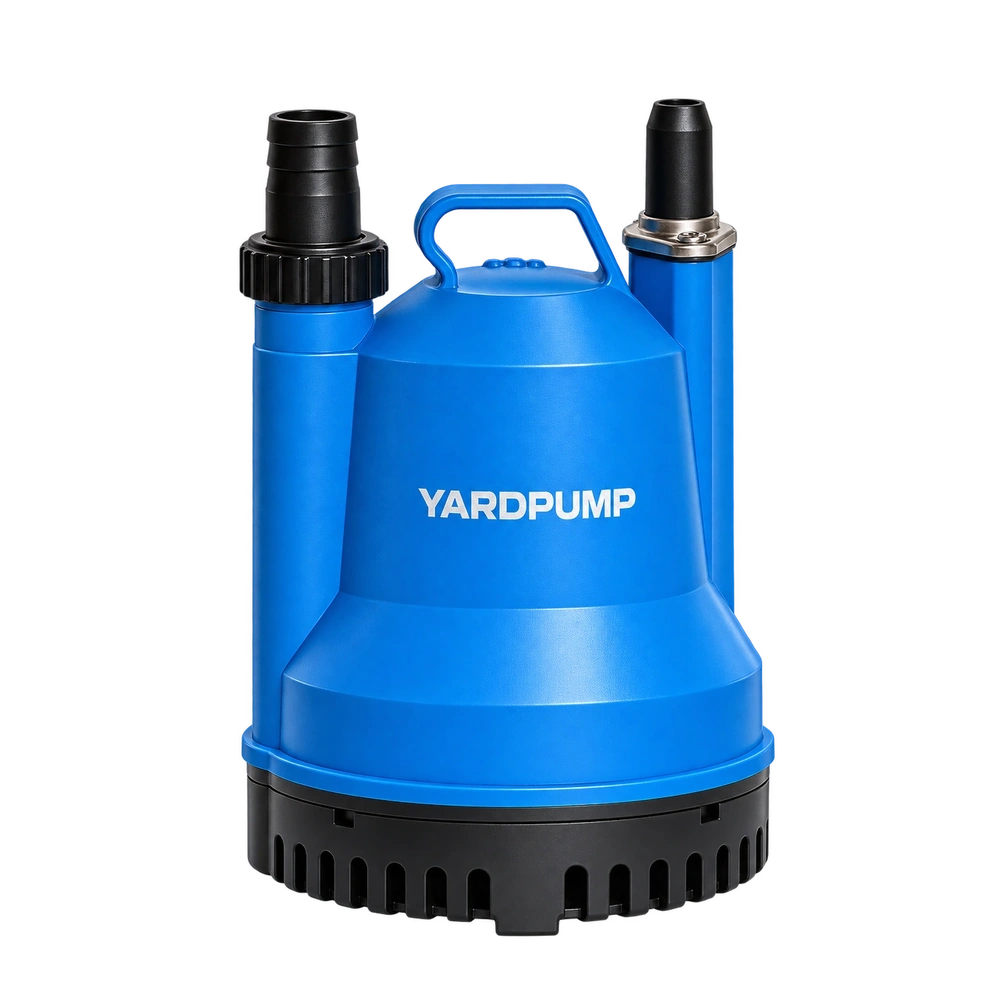
Suppose a clear-water submersible pump feeds a buried garden line from a horizontal rainwater tank. The installed outlet cannot fill a test bucket, and there is no flowmeter. A timed change in tank volume can still give you a useful average flow. Convert the start and finish levels to volumes separately, and account for any other water entering or leaving the tank. The falling level by itself is not a flow reading. In a horizontal round tank, the number of litres per centimetre changes as the level moves.
Why the middle of the tank fools the ruler
Picture a stack of horizontal slices through the tank. A slice near the bottom is narrow. At the centreline it is as wide as the tank. The same drop in level therefore removes more water near the middle than it does near the bottom. A vertical tank with straight sides may have a constant cross-sectional area in its straight section. A horizontal cylindrical tank does not, and moulded end caps, ribs and the bottom pocket can make an ideal cylinder calculation a poor match for the actual vessel.
Use the manufacturer's level-to-volume table if available. Check the level datum on the table, the datum on the gauge and whether the listed volume is total or usable. A gauge referenced to the centre of a connection cannot be read straight into a table measured from the inside bottom. A tilted tank can make a correct table misleading too. If there is no reliable chart, a competent installer can add known volumes and mark a few operating levels; you do not need to guess the curve or drill the vessel to do this.
Keep the delivery arrangement in the test
Choose an interval with steady delivery, before the intake approaches its permitted minimum submergence. Keep the actual hose, valve position, nozzle and receiving point in place. From a dry, safe position, read the external gauge and write down the clock time at both ends. Do not climb into the tank or use the cable to move an energized pump. If the surface moves, take several nearby readings rather than trusting one splash. Note the outlet elevation and whether any other pump or water outlet is active.
Use a time interval that starts after the pipe has filled. Take the ending reading before stopping the pump if water might drain back through the line. If the installation allows it, isolate roof inflow and other water draws before the test. Unmeasured inflow hides part of the volume that the pump sends out; a second withdrawal makes the pump look stronger than it is. If neither can be separated, record net tank drawdown or choose another test window.
What six minutes can tell you
In an illustrative tank chart, the starting level represents 984 litres and the finishing level represents 686 litres. That is a loss of 298 litres in six minutes, or about 49.7 litres per minute with no other flows. If the tank also receives a known, steady 10 litres per minute during the same interval and there is no other withdrawal, the pump is delivering about 59.7 litres per minute. Neither value is a pump rating. If you only know that rain is entering the tank, report 49.7 litres per minute as the net depletion rate and leave the pump's actual flow unresolved.
Water level also changes the elevation difference to the outlet. Run a second comparison over the same range, or measure two narrow ranges separately. If the low-level result is weaker, check the actual outlet elevation, intake coverage and debris before replacing a pump. Change one feature at a time so the comparison can identify what changed.
Use the reading to ask for the right curve
Send the installer or supplier the measured rate, water level interval, nozzle and approximate installed head. Compare a proposed clear-water pump at the duty point. A low residual water figure describes a separate drainage capability; it does not establish pressure at the garden outlet. Where the outlet can safely fill a graduated container, that gives an independent cross-check. For contractual acceptance, or where multiple water paths cannot be isolated, agree on a suitable flowmeter and measurement uncertainty instead of relying on tank drawdown alone.
Frequently asked questions
Does 50 percent level mean 50 percent of the volume?
Not in general. A linear level sensor measures a height fraction. A volume percentage can be converted directly only after the gauge is configured for that vessel.
Should I use the shortest possible timing interval?
No. Make the drop large enough to read clearly, without crossing into a substantially different operating condition.
Does a slow drop after rain prove the pump is weak?
No. Rain inflow, other withdrawals and line drainback can change the level without changing pump performance.