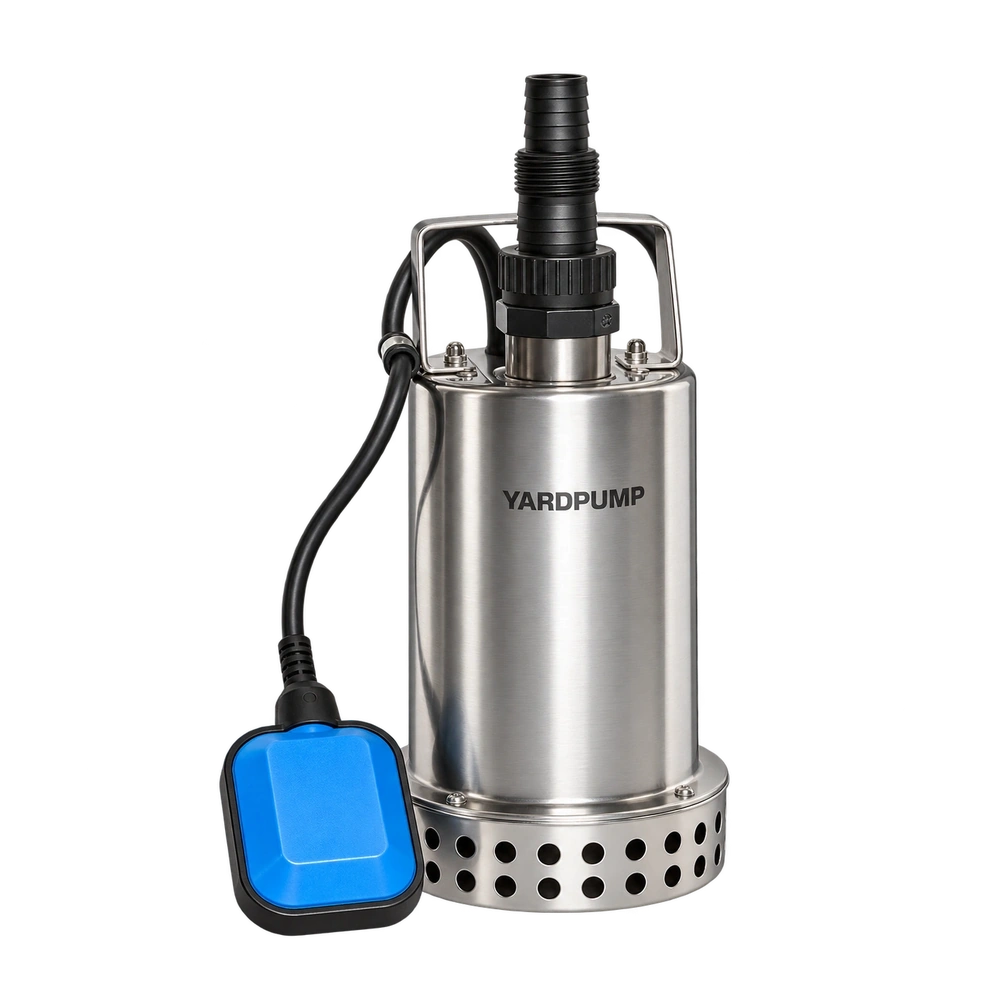
Use this hypothetical selection calculation as an example. A buyer measures six metres from a submerged pump to the discharge and adds another two metres because the pump sits two metres below the water. Has the required lift become eight metres? For two open water surfaces, start with their elevation difference. Pump immersion is not an additional static lift to add again. Lowering the pump within the same source water does change other conditions, which must be checked separately.
Use water surfaces as the energy endpoints
Imagine an open tank feeding an open outlet above it. Water at the pump intake already has pressure from the source water above that intake. Lowering the pump increases that intake pressure while lowering its elevation. In the static energy balance, those two changes cancel. The pump does not start with water at atmospheric pressure down at the tank floor.
For a simple example, the outlet is four metres above the source surface. Whether the intake sits one metre or two metres below that surface, the static elevation requirement remains four metres, provided the source surface and outlet remain unchanged. This is an illustration for an open system, not a model performance claim. The pump's required total head still includes the actual flow-dependent losses and any outlet pressure requirement.
Draw what actually changes when the pump moves
Lowering a pump often lengthens the discharge pipe, changes an elbow position or puts the intake closer to sediment. Extra pipe can add friction at the chosen flow. The hydraulic working point can therefore shift even though the static elevation difference has not changed. A shorter route with a restrictive bend is not automatically better than a slightly longer, correctly supported route.
| Change | Static elevation head | Other check |
|---|---|---|
| Pump lowered, water surfaces unchanged | Unchanged | Added pipe loss and permitted immersion |
| Source water surface falls | Increases for the same outlet | Intake cover and motor operating level |
| Outlet moved higher | Increases | Route, fittings and required flow |
| Receiving vessel becomes pressurised | Pressure term changes | Suitability of pump and complete pressure boundary |
Submergence also affects external pressure on the housing and sealing interfaces. It has a rated limit independent of maximum discharge head. More depth is not permission to exceed that limit, use an electrical connection underwater or operate below a specified minimum water cover.
Calculate at the lowest permitted source level
Suppose the open outlet is initially four metres above the source surface. At the target flow, the documented hose and fittings lose two metres, giving approximately six metres of required head. If the source surface falls another metre, the static part becomes five metres. The same two-metre loss estimate would give about seven metres at that target flow. The actual flow then depends on the pump curve and system intersection, so losses should be recalculated if flow changes.
All numbers here are hypothetical. They do not describe a particular YARDPUMP model, and a maximum-head figure cannot be used as a delivered flow point. For a sprinkler or other pressure-consuming outlet, add its required pressure at the intended flow as well. For two tanks, consider both the falling source level and rising receiving level over the transfer.
Keep installation limits next to the head calculation
For a small clean-water or clean/dirty-water submersible pump, retain the minimum operating level, maximum immersion, permitted liquid and intake-clearance requirements with the route sketch. Locate the intake to avoid unsuitable sediment without assuming that deeper is always safer. Water level, cable reach and a supported discharge connection all need to fit the approved arrangement.
If the source or receiving vessel is sealed, do not apply the open-surface calculation without including their pressures. Siphon-assisted downhill routes and temporary air pockets also need their own assessment. Have qualified personnel isolate electrical equipment before relocating a pump. Move it by the approved lifting provision, not the power cable. The practical purchase specification should state source-level range, outlet elevation, target flow and route; pump-to-outlet distance alone is incomplete.
Frequently asked questions
Does lowering the pump increase its maximum head?
It does not change the pump's own curve by adding immersion to the advertised head. It changes intake pressure and potentially the installed losses and conditions.
Can a deeper position improve air intake problems?
Adequate inlet cover can help in an approved installation. Check approach flow, vortices, sediment and the actual immersion limit before moving the pump.
Is cable length a valid substitute for a depth rating?
No. Reach, maximum immersion, electrical connection position and strain relief are separate requirements. Use the exact model's approved instructions.