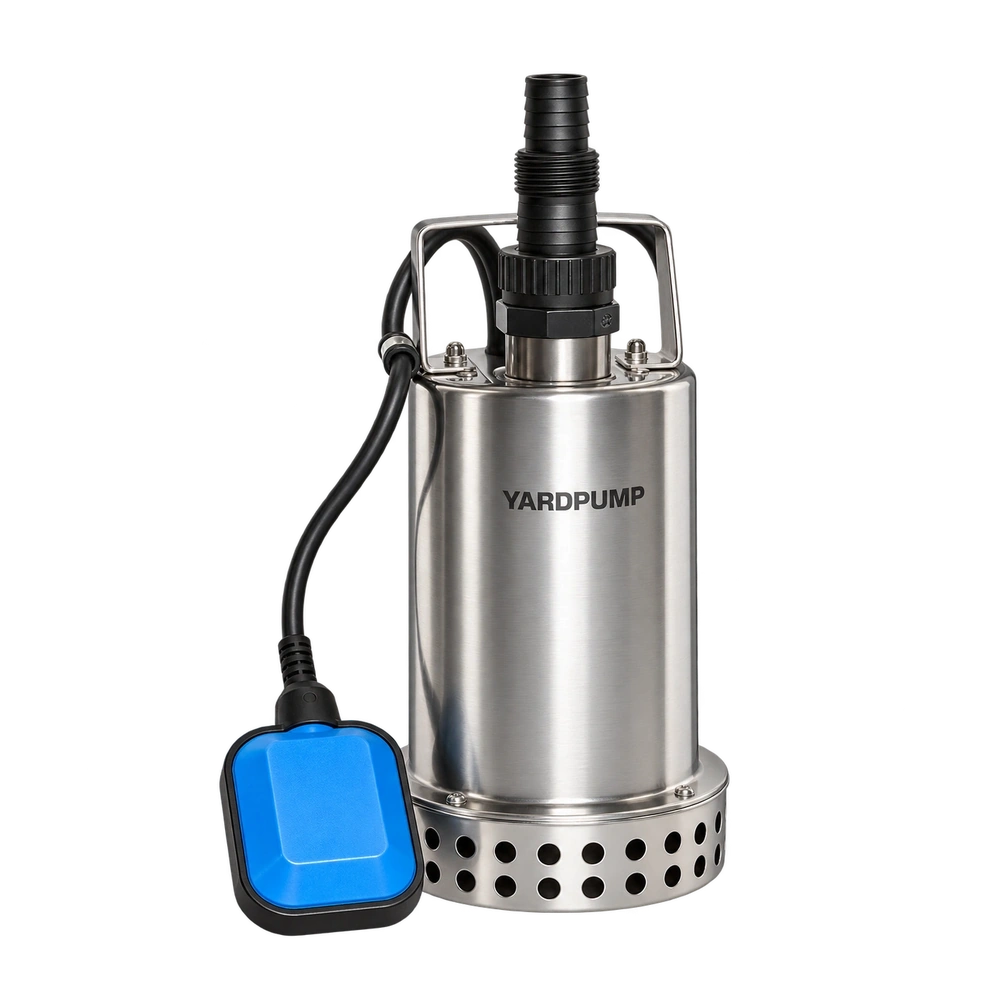
A small submersible clean-water pump waters a garden from a rain barrel through a regular rubber hose. With an expandable hose fitted, only one section fills out and the outlet barely drips. If the ordinary hose still works for the same job, check whether the expandable one has the pressure and open flow path its manufacturer requires. An elastic hose develops its usable length and passage as it fills under pressure. The pressure at that hose under normal flow is neither the pump's advertised maximum head nor its maximum flow.
An expandable hose has to form its flow passage
An ordinary hose already has a usable cross section when empty. Kinks, the bore, length and fittings still limit flow. An elastic expandable hose has an inner tube that stretches within a restraining layer. Its length and internal shape can change with water pressure. Some models are intended for a household tap, so matching the connector does not mean that a low-head drainage pump can extend the hose completely. A particular pump and hose may still pass a little water before the hose extends, but the small passage can change watering time or the performance of the outlet.
Check the nozzle, coupler and any self-closing parts for restrictions or shipping plugs; any valves needed for the comparison should be in the approved open position. If the hose works on another approved supply, that shows the combination matters, but it does not isolate the exact restriction. Do not close the outlet to force the hose to fill out. Some drainage pumps are not designed to run with the discharge closed, and an inflated hose under static pressure does not establish flow.
Compare delivery at the same lift and outlet
Start with the pump safely disconnected before swapping hoses. Follow the pump instructions for starting depth, placement and electrical supply. Use an ordinary hose of known bore that is approved for the pump. Set up both hoses for the same safe, visible discharge location, with the same outlet elevation, fitting opening and source water level as far as practical. Compare approved open-outlet arrangements, collecting a known volume over a measured time. Record how far the hose extends and whether water delivery is continuous. Do not pinch a pressurized fitting or test in a flooded area or with damaged electrical equipment.
If both hoses deliver poorly, check intake water level, debris, routing and actual vertical rise. If the ordinary hose delivers steadily at the same task but the expandable one remains constricted, select a suitable ordinary hose before replacing the pump. If an expandable hose is necessary, ask its supplier for the requirements to extend and deliver with the outlet open, including flow, pressure, permitted maximum pressure and fitting conditions. Have qualified staff verify delivery at the same point. Do not assume a generic household water pressure stands for the manufacturer's requirements.
Work out how much pressure is available at the required flow
In a simplified example, a pump curve gives 4 m of head at 15 L/min. By the inlet to the expandable hose, 1.5 m is used in elevation and about 1 m in upstream losses. Ignoring the small velocity term, that leaves about 1.5 m of water head, or 0.15 bar. Suppose a hose needs at least 0.6 bar at its inlet at that flow. That target point is not achievable in the example; it does not mean there will be no water under every other condition. The numbers are illustrative, not a model specification. For the real job, confirm the hose requirements, discharge conditions and the pump's permitted operating range.
If the task is drainage or moving rainwater to an open hose end, use an approved conventional hose that fits the route and delivers enough water. When a nozzle is part of the job, include its flow and pressure requirements. A hose's maximum working pressure is a limit; its pressure requirement for extending and delivering is a different figure.
Frequently asked questions
Could shortening the expandable hose solve the problem?
Do not cut it down. The end fittings, retention and seal are part of the complete assembly. Use a shorter approved conventional hose if it does the job.
Why does the hose shrink when I open the nozzle?
Once water moves, the pump output and losses change. Check the conditions for delivery with an open outlet rather than whether the hose extends under static pressure.
Can I compare pump maximum head directly with a hose pressure figure?
First identify whether the hose figure is a requirement for extension or a maximum pressure limit. Then compare it with actual pressure at the hose inlet at the required flow.