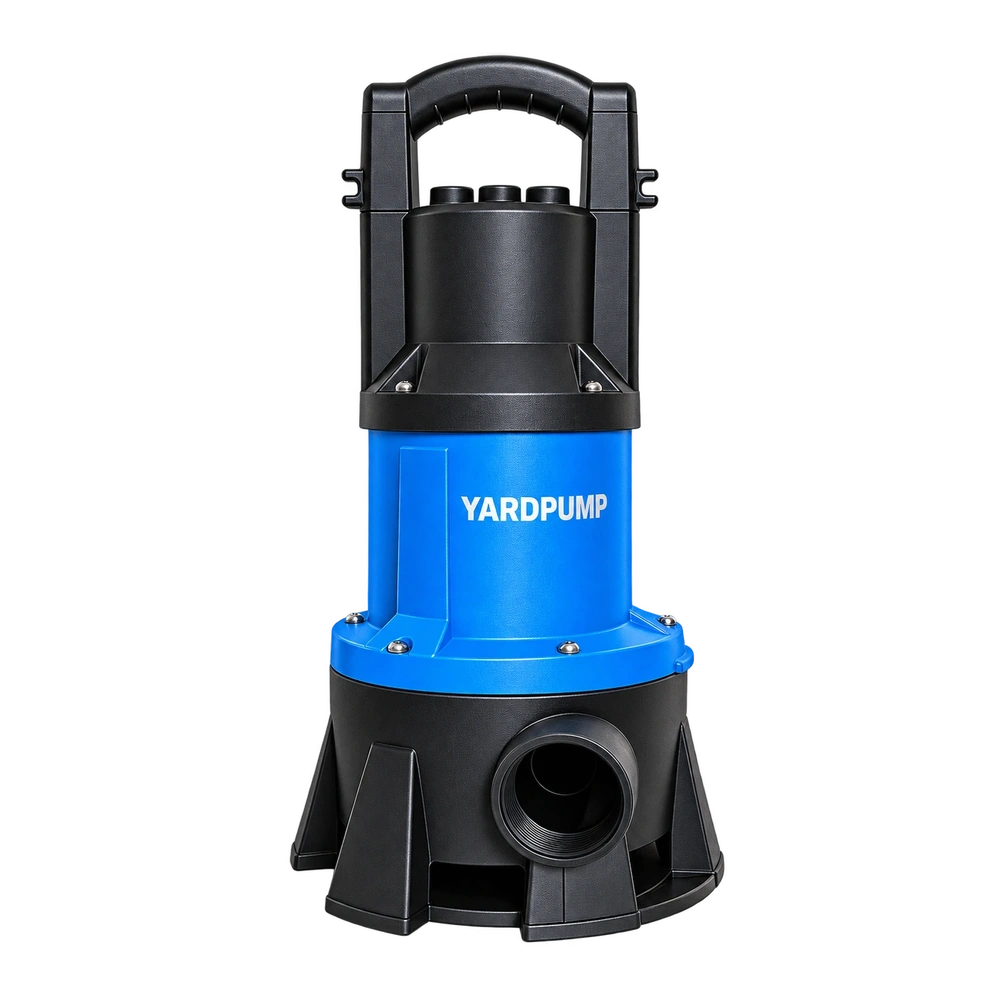
A water barrel cannot accommodate an existing submersible pump. Could the pump sit outside, with a hose attached to its inlet? For an ordinary portable pump that requires submerged operation, that modification must not be assumed acceptable. It changes the suction, venting, cooling and sealing conditions. Only a specific design approved for external or pipe-connected operation should be used that way.
A connection does not establish suction capability
A surface self-priming pump and an ordinary submerged pump can have very different starting arrangements. Many submerged centrifugal pumps rely on surrounding water entering the chamber. Their inlet is not necessarily a connection designed to be sealed to suction pipework.
With air in the chamber, a rotating impeller may not produce enough suction to lift water and complete priming. An inlet adapter does not add the internal air-handling arrangement that a self-priming design may require.
Even successful operation after manual filling proves little about restarting. Water can drain away during a stop, small connection leaks can admit air, and a falling tank level changes the conditions. One successful demonstration does not establish an approved operating range or suitability for unattended use.
Cooling is a separate requirement
A submerged motor may depend on surrounding liquid or a particular flow path for heat removal. Water passing through the impeller does not necessarily cool the motor adequately when the casing is outside the tank.
Check the actual model's minimum operating level, liquid temperature, duty and installation limits. Designs differ, so neither a general ban covering every pump nor a blanket permission is justified. The manufacturer's instructions for that configuration are decisive.
Mechanical seals and other contacting components may also require specified liquid conditions. No visible external leak does not prove satisfactory seal lubrication or temperature. Never bypass a thermal protector or level control to force an improvised arrangement to continue running.
| Changed condition | Evidence required |
|---|---|
| Pipe connected to the inlet | Approved connection and suitability for suction conditions |
| Motor outside the water | Adequate cooling in that installation |
| Air present at starting | Appropriate priming and air-release capability |
| Restart after a stop | Control of water loss, air entry and dry running |
Translate the real need into a purchase specification
For barrel-to-garden transfer, record the opening dimensions, liquid-level range, discharge height, required flow and pipe route. Then compare an appropriately sized submerged pump, a suitable barrel pump or a surface pump designed for the suction task.
Consider a hypothetical case in which the original pump is too large for the barrel opening, while the watering duty has not changed. The solution is not automatically a smaller inlet adapter. An alternative submerged model must fit and meet the task, or an external arrangement must be selected against its own suction and cooling requirements.
Do not interpret maximum discharge head as maximum suction lift. Suction performance has separate limitations involving pressure, temperature, line losses and priming. A published high-head figure cannot validate an improvised external installation.
Include restart conditions in validation
If a supplier claims a model permits external operation, request the relevant installation instructions, interface details, cooling conditions and suction limits. A short video showing water emerging is insufficient.
Under the approved procedure, validate initial starting, restarting after a stop, the specified lowest water level and the intended operating duration. Record flow, input power, abnormal heating and protective actions. The aim is to verify the authorised configuration, not to discover how long an unauthorised modification survives.
Testing belongs to competent personnel using suitable facilities. End users should not be asked to dismantle or reconnect energised equipment. Where immersion is explicitly required, retain the approved installation or choose another model.
Give distributors precise language
Find out whether the customer's actual constraint is opening size, available space, noise or access for service. Then explain an appropriate configuration rather than adding capabilities to the existing product.
Sales descriptions should distinguish submerged operation, an approved pipe connection, permitted external use and self-priming. One attribute does not imply all the others. This discussion establishes a selection method; it does not claim that every submersible design prohibits external use or that any particular model permits it.
Frequently Asked Questions
Does working after manual filling prove external suitability?
No. Restarting, cooling, sealing and the full operating range must also be approved.
Is maximum discharge head the same as maximum suction lift?
No. They describe different conditions and limitations.
Can the thermal protector make a trial safe?
A protector is not installation approval. Confirm model suitability before operation rather than relying on repeated protective trips.