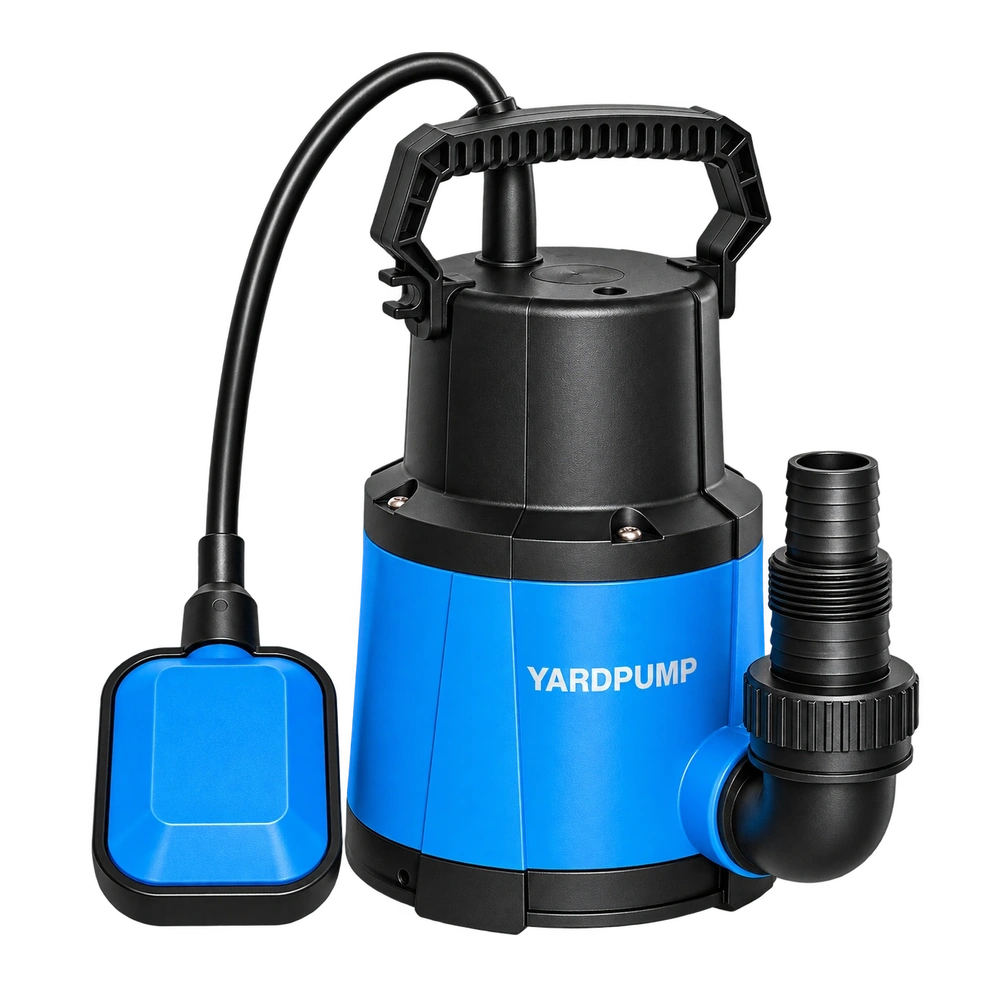
A rain barrel already has a submersible pump. Can its hose simply be connected to a pressure washer? In this typical pairing question, compatibility depends on the washer's permitted water-supply arrangement and the pump's delivery through the actual pipework. The transfer pump supplies the inlet; the washer creates its own high discharge pressure. Neither the washer's outlet-pressure headline nor the transfer pump's maximum flow establishes a suitable match.
Read the washer inlet requirements first
Identify minimum water supply, permitted inlet pressure, maximum inlet temperature, water quality and filtration requirements. Confirm whether the exact washer allows supply from a tank. Some machines accept a specified suction arrangement and accessories, while others require a positive-pressure supply. Similar appearance does not establish identical requirements. Use the instructions for the particular version rather than another owner's successful arrangement.
Then establish what the transfer pump can deliver along the complete route. Lift from the barrel, hose length and bore, fittings and filtration losses affect the operating point. Maximum head and maximum flow usually describe different ends of a pump curve. Buyers should check stable delivery at the installation duty and verify that the resulting inlet pressure remains within the washer's permitted range.
Coordinate two operating cycles
Imagine, purely as an example, a washer requiring 6 litres per minute under its specified conditions and a feed pump advertised at a maximum of 12 litres per minute. That does not prove compatibility. If lift and system losses reduce actual delivery to 4 litres per minute, the supply is inadequate. Adequate flow also does not remove the separate inlet-pressure check. These figures are illustrative, not specifications for any product.
Closing the spray gun introduces another operating state. The washer's demand may change or stop while the upstream pump continues running. Whether that pump tolerates a brief low-flow or closed-outlet condition requires confirmation. Automatic stopping in the washer does not automatically control a separate submersible feed pump. Repeated thermal trips are not a substitute for a suitable coordinated control arrangement.
| Pairing question | Evidence needed |
|---|---|
| How may the washer receive water? | Exact model supply mode and inlet limits |
| What can the pump deliver? | Stable flow through the installed route |
| What happens when the gun closes? | Both machines' control and operating boundaries |
| Is the stored water suitable? | Water quality, filtration and maintenance requirements |
Filtration changes both cleanliness and pressure
Rainwater can contain sediment, plant fragments and other particles unsuitable for washer valves or nozzles. A pump's ability to pass a particle does not establish downstream tolerance. Check pump inlet protection and the washer's filtration requirements separately. The pump's solids-passage figure must not become a substitute for the water-quality specification of the complete system.
A filter also creates pressure loss, which can increase as it becomes dirty. One successful trial with a clean element and a full barrel may overlook later starvation. Include lower permitted water levels and realistic filter conditions when assessing the arrangement. Check for kinked hoses, collapsing suction components where relevant and air leakage. Position the intake to avoid continuously drawing accumulated bottom sediment into the supply.
Trial the complete arrangement
Validate the approved connection method, pipework and controls as one package. Observe initial start, continuous demand, gun closure and reopening. Record supply interruptions, abnormal sound, protection operation and unsuitable pressure. Maintain each machine's prescribed cooling and safety conditions throughout. A successful open-hose test of the feed pump alone does not demonstrate coordinated operation with the washer.
Do not casually interconnect rainwater and drinking-water supplies. Outdoor equipment labels also do not authorize placing electrical connections in standing water. Competent personnel should confirm electrical protection and any backflow arrangements required at the site. The useful purchasing decision is a pair of machines that work together through their permitted operating states, rather than two products with impressive but unrelated headline figures.
Questions about pressure-washer supply
Must the feed pump produce the washer's spray pressure?
No. Match the washer's inlet flow and pressure requirements; its internal system creates the high-pressure discharge.
Can the upstream pump remain on when the washer stops?
Only within its confirmed operating limits and the approved control arrangement. Do not assume permanent closed-outlet operation is acceptable.
Is water acceptable because the drainage pump can handle it?
Not necessarily. The washer can have stricter filtration and cleanliness requirements, and filter pressure loss must be included.