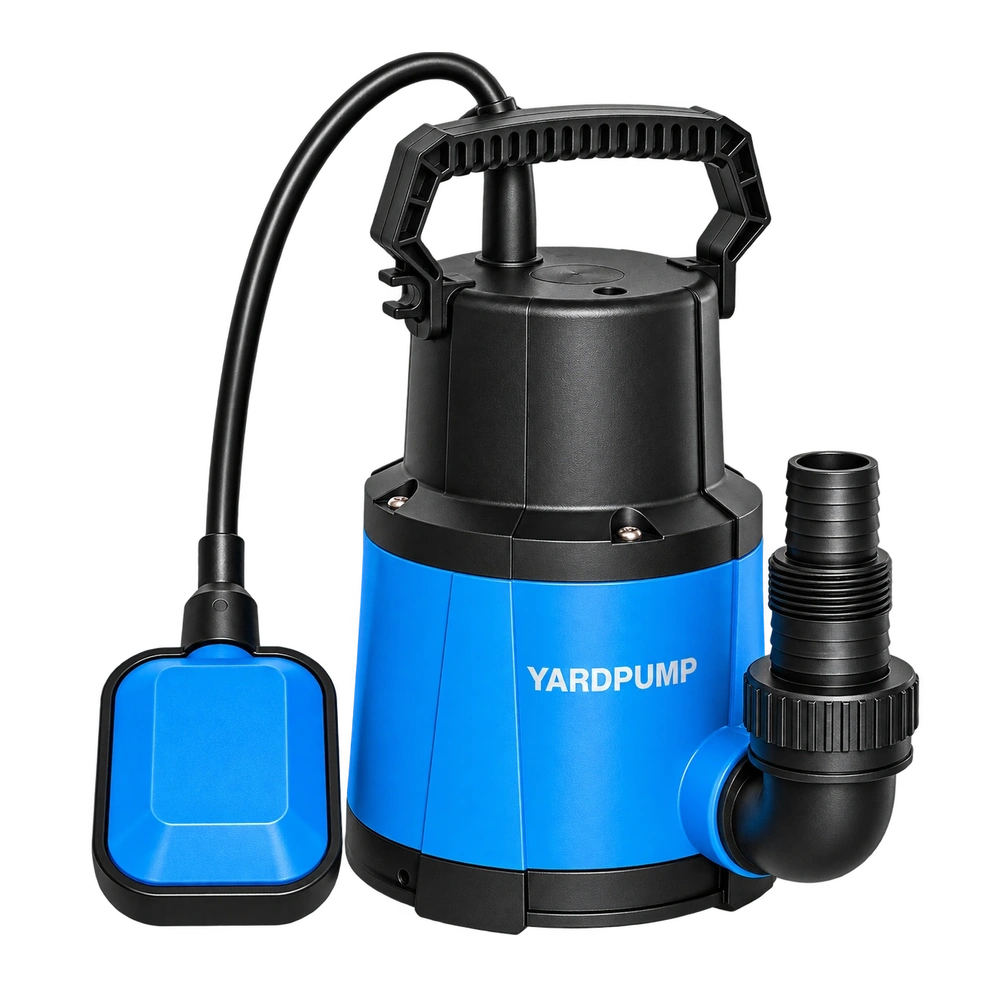
Say you feed a garden hose with a submersible pump in stored rainwater. Its discharge looks white, then clears in a transparent container. Does the pump need replacing? First check whether tiny bubbles are responsible and when they occur. A sample that clears from the bottom upward suggests rising bubbles. That observation does not tell you whether gas appeared at the inlet, in the line or after the water left the hose.
Similar-looking bubbles can have different sources
Water can carry both dissolved gas and bubbles. Dissolved gas can come out of solution when pressure falls or other conditions change. An inlet that remains under water can still send water that forms fine bubbles as it emerges into the atmosphere. Temperature also influences gas solubility. In addition, a jet that falls into a bucket or is broken up by a garden nozzle can mix with air at the outlet. Neither observation necessarily changes the pump’s delivered flow. An outlet full of fine white bubbles is not reliable evidence about the condition of the pump seals.
Air can also enter through a surface vortex as the source level falls towards the inlet. A refill stream splashing into the intake area can carry bubbles down to a submerged pump. Delivery may then sputter, start and stop, or vary with water level or the pump’s location. The first air pushed out of a drained hose is another possibility. Its timing usually follows the first start in that condition. A photograph of bubbles cannot show all of those differences.
Compare samples and observe delivery through the cycle
Where it is safe to collect clean water, take a source sample and a sample at the discharge in similar clean, transparent containers. Keep the sampling conditions comparable and avoid letting the sample fall a long way into the container. Do not reach into the pump water or adjust fittings while the pump is running. Set the samples in similar light. Note where the haze disappears and whether there is any deposit. Small bubbles rise; heavier solid particles may settle and leave material behind. Some suspended matter settles slowly, so a sample that does not clear quickly is not proof of a specific contaminant. The comparison does not establish that the water is safe to drink or touch.
Record what happens just after startup, at a stable level and near the normal stop. Look for a surface vortex and see whether the delivered flow actually changes. If a nozzle could be mixing air with the stream, qualified staff can compare with a suitable free outlet after isolation and depressurization, within the equipment instructions. Do not add unapproved clear hose or loosen a pressure connection to see what comes out. Use a suitable collection arrangement so that air added during sampling is not mistaken for a pump symptom. If foam appears only where the spray lands, observe the free jet from a safe position first. Record where you saw the change so service can repeat the comparison.
Use the pattern to decide what needs attention
In an illustrative comparison, both samples clear in similar fashion, delivery stays steady and there is no visible vortex reaching the inlet. Review the source water, nozzle and sampling method before opening the pump. In another, the stream sputters only at low level, the source sample remains clear, and a vortex is visible at the inlet at the same time. Restore the submergence and intake arrangement permitted for that model, then verify delivery and automatic operation. Stop using equipment with persistent loss of flow, unusual noise or an electrical trip and have it inspected. Bubbles alone neither diagnose cavitation or a seal fault nor rule out a separate problem.
Frequently asked questions
Does white water with no sediment prove it was only air?
No. Clearing as bubbles rise supports that explanation. Compare the source, the sampling method and whether delivery was steady.
Do bubbles for a few seconds at startup mean the pump leaks air?
They can be air displaced from a drained hose. If the stream becomes steady, check whether the pattern appears only after the line has emptied.
Can a finer intake screen remove the white bubbles?
A screen stops suitable solids. It does not simply remove dissolved gas, and it may add inlet restriction. Identify the source before changing the screen.