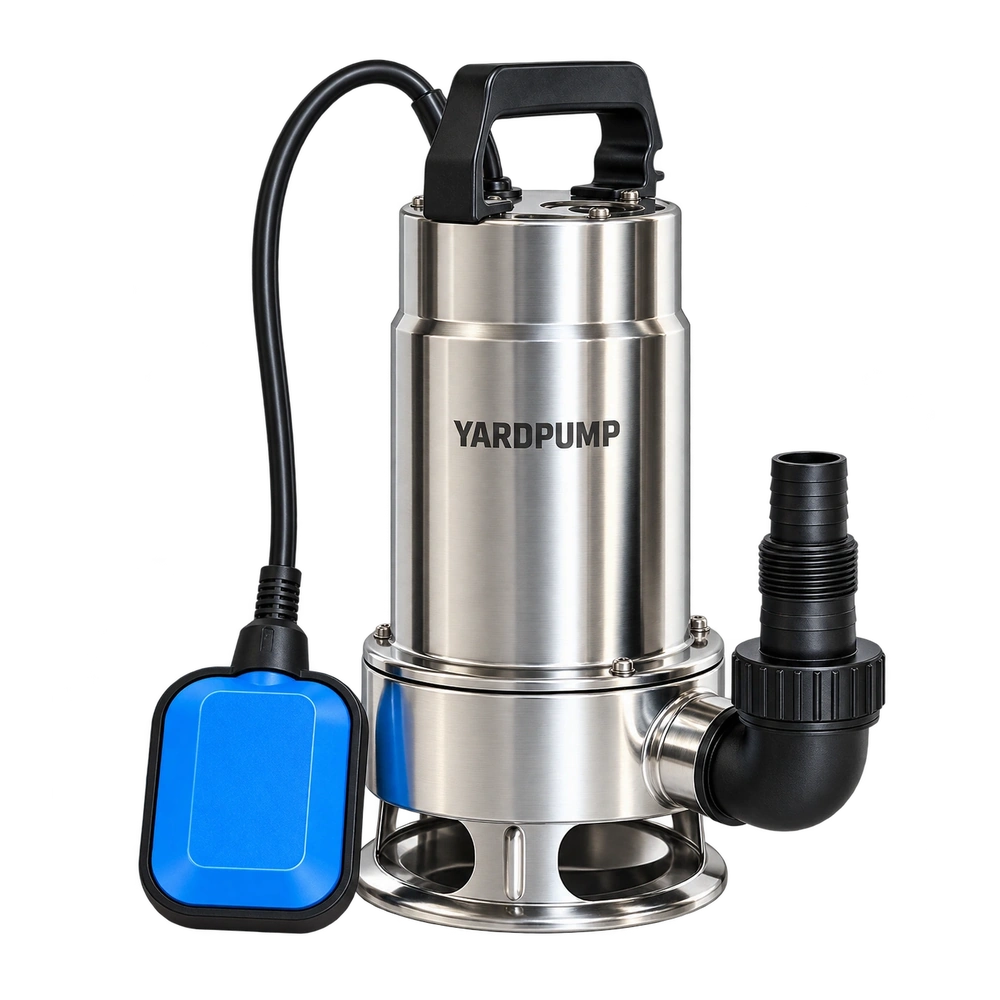
Consider this illustrative sample-inspection question. “The casing still feels cool after an hour underwater. Does that mean the winding temperature is safe?” This is a plausible sample-inspection question, but a cool surface does not establish a safe winding temperature. Water can remove heat from the outside while the copper inside runs substantially hotter. Acceptance requires the applicable measurement method, operating duty and temperature limits, rather than an impression of the casing.
Follow the heat path before comparing readings
Copper and iron losses generate heat inside the motor. Heat then passes through insulation, impregnation, the core, housing and their interfaces before reaching the water. The resistance of that path depends on the construction. Poor contact, an internal air gap or a change in encapsulation can raise winding temperature without creating the same change at an external measuring point.
Three measurements must remain distinct: average winding temperature, the hottest winding location and casing temperature at a particular point. A resistance measurement, performed under the prescribed procedure, can establish an average winding temperature. An embedded sensor measures conditions near its position. A surface thermocouple measures the surrounding surface. None should be relabelled as another measurement, and an average is not a direct measurement of the hottest point.
A numerical example explains the apparent contradiction
The following values are illustrative, not product specifications. Suppose the water is at 30°C, a casing sensor reads 45°C and an appropriate method establishes an average winding temperature of 95°C. The casing is 15 K above the water, while the average winding is 65 K above it. These results are compatible with a temperature gradient through the assembly.
Those numbers alone do not prove compliance or noncompliance with an insulation class. The applicable assessment may specify reference conditions, measurement methods, corrections and limits. Supply conditions, hydraulic load, immersion and thermal stability also matter. A purchase specification should identify the assessment method instead of requiring an arbitrary surface temperature or a pump that “does not feel hot.”
Request a temperature report that describes the operating task
A useful report records voltage, frequency, actual flow and head, input power, running time, water temperature and installation orientation. Changing the discharge restriction changes the operating point. Heating the test tank changes the cooling environment. A photograph of a temperature display cannot establish whether the sample was performing its rated task or running at a much lighter load.
Record sensor locations, instruments, attachment methods and sampling intervals. An ordinary infrared camera pointed through water generally does not measure the hidden casing surface accurately. Use sensors suitable for the submerged environment and a validated installation method. A loose sensor or an attachment that alters local heat transfer can produce a convincing but misleading trace.
Qualified personnel should conduct winding-temperature tests. If a prescribed resistance method uses measurements after stopping, the winding cools during the delay. The timing and required calculation or extrapolation must therefore be documented. Do not open an energised pump or ask anyone to touch an operating pump or its water to assess heat or electrical safety.
Compare design changes under equivalent conditions
For a before-and-after comparison, hold the hydraulic task, electrical supply, surrounding water temperature and installation conditions consistent. Record the approach to the required stability criterion. A cooler motor that produces less useful output, or that has run for less time, has not necessarily gained better cooling.
Changes to the stator, winding, potting, housing material or chamber arrangement may alter internal heat transfer. Treat a low casing temperature as one observation alongside winding measurements, electrical losses, protection behaviour and insulation checks. If the casing stays cool while the winding runs abnormally hot, investigate the heat path, actual losses and measurement quality. Raising the protector setting does not resolve that discrepancy.
State the boundary of the conclusion
This approach explains temperature evidence; it does not assign a maximum water temperature, minimum immersion depth or insulation rating to any pump model. Passing one submerged test does not establish suitability for partial immersion, dry running or a different duty. Keep the validated configuration and conditions attached to the acceptance statement so distributors can explain what was actually demonstrated.
Frequently asked questions
Can casing temperature support routine production monitoring?
Yes. A fixed measuring point under controlled conditions can reveal batch drift. Establish its relationship to formal temperature-rise validation first; it does not independently replace winding assessment.
Does a higher insulation class permit every component to run hotter?
No. Capacitors, bearing lubrication, seals, plastics and protective devices have their own limits. The winding insulation class alone does not define the operating limits of the complete pump.
If the thermal protector never trips, has the pump passed the temperature-rise test?
No. Protector location, response and tolerance influence its operation. Protective intervention and temperature-rise acceptance under specified conditions are different assessments.