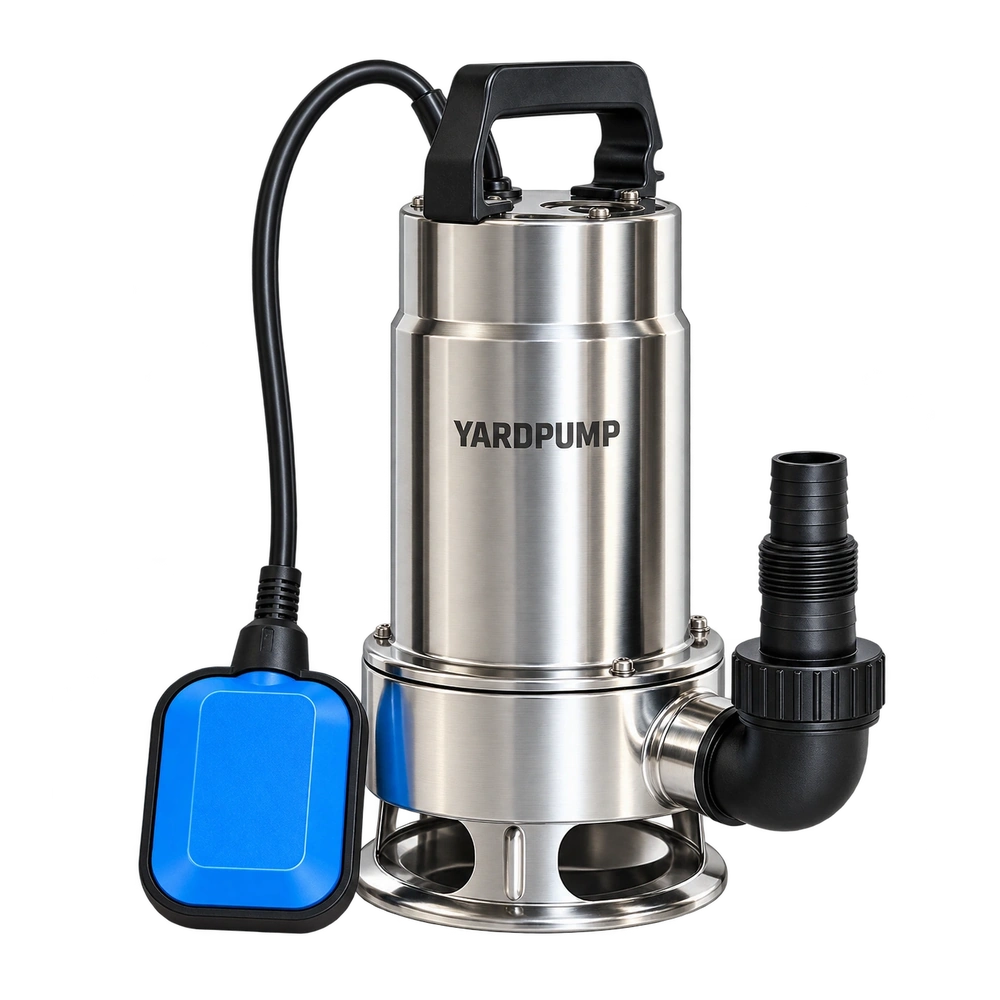
A returned pump has an apparently intact stainless screw beside a badly corroded aluminium component. Does that prove poor aluminium quality? Not necessarily. Electrically connected dissimilar metals exposed to a common conductive liquid can form a galvanic couple. Investigate the materials, environment, areas and corrosion pattern rather than judging only the component that looks worst.
Connect the necessary conditions
Galvanic corrosion generally involves metals with different electrochemical behaviour, an electrical connection and a common electrolyte. Salinity, temperature, oxygen availability and deposits can influence the result.
Contact between different metals alone does not establish an identical corrosion outcome in every environment. Surface condition and local exposure also matter.
In some aluminium and stainless combinations, aluminium can be the more readily attacked member. The actual rate cannot be estimated from those material names alone. A plastic casing with stainless fasteners likewise does not establish complete-pump suitability for seawater.
Consider the exposed-area relationship
A relatively large cathodic area coupled to a small exposed anodic area can concentrate attack on the smaller region. A coating defect can therefore matter beyond its percentage of the overall component surface.
Assess what is actually exposed and electrically connected. Simply reducing the number of screws does not necessarily resolve the relationship.
| Evidence | Why it matters |
|---|---|
| Metal grades and surface treatments | Establish the actual material combination |
| Contacts and conductive paths | Determine the electrical connection |
| Medium and wet-dry exposure | Establish electrolyte conditions |
| Attack pattern and exposed areas | Evaluate concentration and alternative mechanisms |
Geometry, coating integrity and environmental conditions belong in the same assessment. A material ranking without those details is an incomplete selection tool.
Do not label every corroded joint galvanic
Crevice conditions, damaged coatings, contamination and general chemical attack can also concentrate around fasteners. Preserve photographs and samples before cleaning, and relate the pattern to metal loss and service history.
Rust-coloured staining does not by itself establish the mechanism. Nor can a single photograph support a service-life prediction.
For a hypothetical investigation, corrosion around an aluminium screw hole coincides with stainless contact and saline exposure. Galvanic action is a reasonable hypothesis, but crevice effects, coating condition and actual grades still require assessment. This is not a seawater test result or permission to use a standard pump configuration in seawater.
Validate the complete prevention method
Design options can include appropriate material combinations, reliable isolation, surface treatment and avoidance of trapped liquid. Their suitability depends on the actual joint.
One insulating washer may leave contact through threads or another conductive route. Coatings need durability and control of assembly damage rather than an assumption that coverage remains perfect.
Changes must also preserve clamp load, sealing, dimensions and electrical functions. Do not interrupt a necessary protective-earth path to reduce corrosion. Unknown sealants or improvised coatings are not a validated isolation system.
Competent design personnel should assess the mechanical and electrical implications and verify the complete arrangement under relevant exposure.
Make procurement claims configuration-specific
Specify wetted metals, surface treatments, permitted media and installation and maintenance conditions. For special corrosive applications, request evidence matching the actual configuration.
A statement about one metal's resistance does not establish complete-pump compatibility. Short-term exposure results also need a justified method before they are used to infer long service life.
Where corrosion creates structural or electrical concerns, stop use, isolate power and obtain qualified assessment. Users should not replace screws experimentally and return the pump to service without the required checks.
Post-repair mechanical, sealing and electrical validation may be necessary. Effective prevention controls the material-environment combination rather than automatically replacing the most visibly attacked part with a more expensive metal.
Frequently Asked Questions
If stainless remains clean, can it be excluded from the mechanism?
No. The more resistant member can still participate in a galvanic couple.
Will an insulating washer necessarily solve the problem?
No. Check other conductive paths and the durability of the isolation.
Does one salt-spray result prove long-term seawater suitability?
No. Conditions and mechanisms differ; obtain relevant complete-configuration evidence.