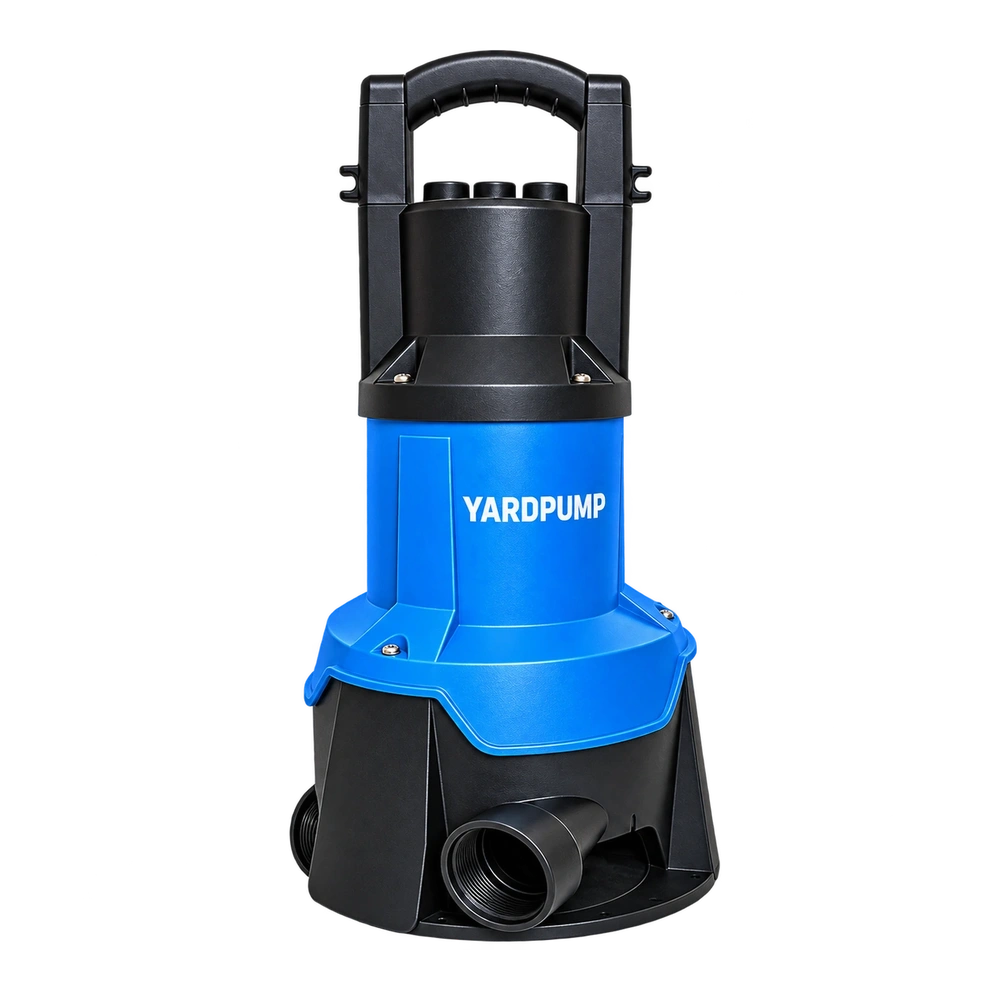
A temporary water tank has a low opening. The pump body just fits upright, but the outlet elbow and hose do not, so laying the entire unit on its side looks like an easy solution. Only do that if the manufacturer explicitly permits the orientation for that pump and its control assembly. Submersibility says the specified installation can tolerate immersion under approved conditions. It does not authorize operation in every direction. If the manual shows an upright base and does not allow a side mount, find another arrangement.
Read the drawing as a whole assembly
Check the allowed shaft or body orientation, how the pump is supported and the clearance around the inlet. On a bottom intake design, the base may define a deliberate gap between the suction opening and a flat floor. On its side, the intake can face a wall, sit over a seam, draw air sooner or lose access to the last layer of water. The outlet and top housing may become load-bearing surfaces even though they were not designed to hold the pump’s weight.
Orientation can also affect the exit path for trapped air. The vent that lies high in the wet end during upright operation may be lower in a side installation, depending on the geometry. A pump can run and move some water during the first wet test without demonstrating stable restarts at low water. If the design relies on a particular wetted area or internal flow to carry away heat, the relevant approval includes that minimum level and operating duty. Do not infer an allowed angle from the enclosure rating or from a short trial.
Account separately for the control. A tethered float needs room to swing between its switch positions. A guided float must be able to move on its guide in the specified direction. An electronic sensor may be mounted at a height chosen for the upright design. Turning the whole unit changes the relationship between the sensor and the inlet. A model that runs in manual mode may still be unsuitable for automatic service at that position. Do not tie the float in place or defeat a protection to fit the pump.
Measure clearance before buying anything
Take three measurements: the opening height for passing the unit through, the working height over its base, and the lateral distance needed for the outlet, hose bend and control movement. Add the space needed to remove the pump without pulling on the cord. Lay out the unit and fittings dry and unplugged. Ask how it will rest when the hose fills and whether service staff can still access the connection after installation.
In an illustrative tank, there are 240 mm between the floor and lid. A pump stands 180 mm tall, and the straight adapter plus the hose bend need 90 mm more, for a 270 mm envelope. It is short by 30 mm even though the bare pump fits. If a specified low outlet elbow and a supported lateral hose need only 45 mm above the pump, the resulting 225 mm envelope leaves 15 mm for other tolerances. That number is just dimensional space. The installation still needs the manufacturer’s stop/start levels, wiring and retrieval clearances, and the required bend radius.
Choose what to change and what to verify
First see if the problem is just an outlet connection. An approved elbow or swivel can reroute the hose while keeping the body and control in their intended position. If the opening itself is too small, choose a lower-profile pump or have the layout changed. A pump with a manufacturer-approved horizontal installation can be a candidate, but check the supports, medium, water levels and access for that orientation before ordering.
The installation check should observe startup, stable delivery and shutdown within the stated water-level limits, including an ordinary restart. Isolate at a dry, safe point before moving the unit or making changes. Never run it dry to prove the lowest possible residual level. If the installation cannot maintain the required inlet depth or allow the control to move freely, revise the layout before service.
Frequently asked questions
Does a side outlet mean the pump can be laid down?
No. Outlet direction and approved body orientation are separate features.
Can I wedge a pump in place with a block?
Use approved support or mounting that does not obstruct the inlet or stress the housing. A loose block can shift or restrict the control.
Will a smaller pump always fit more easily?
Check the complete arrangement. A smaller body may still require a large adapter, wide float travel, or a hose that cannot make the available bend.