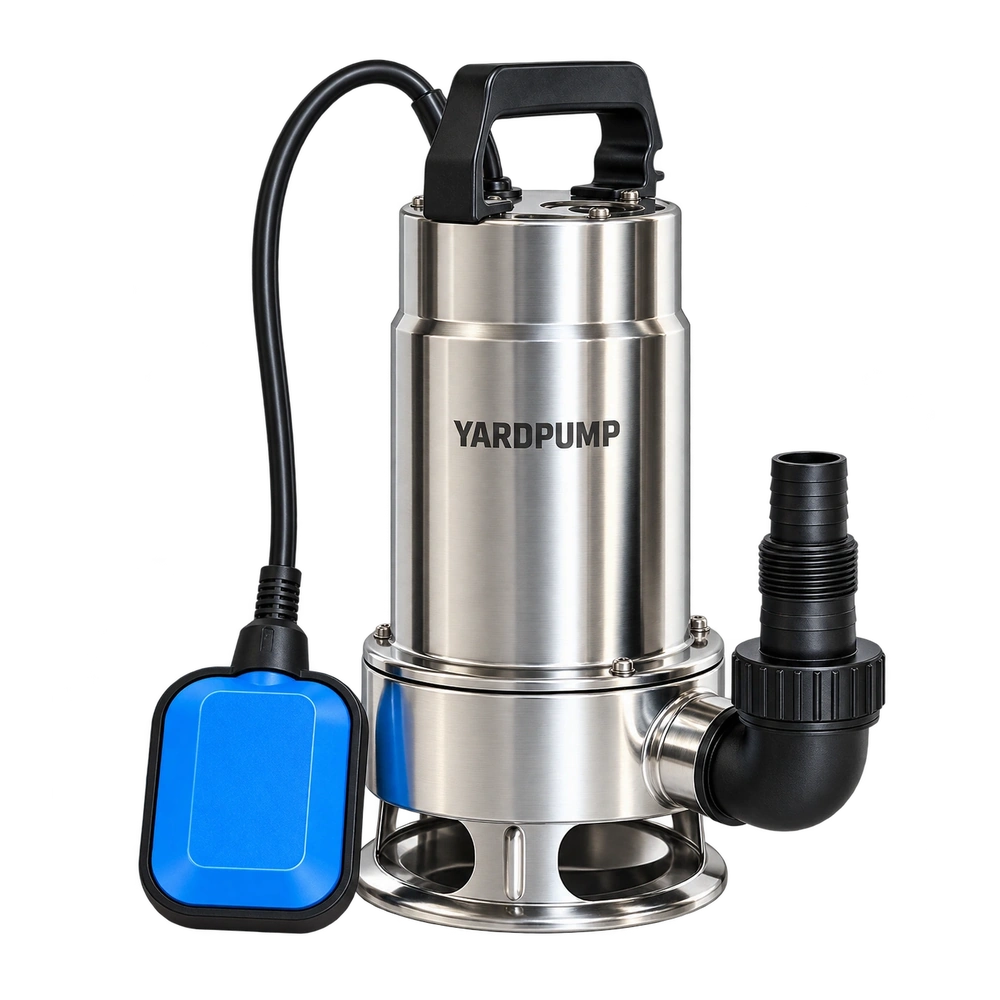
In a typical sump installation, the float moves freely by hand, yet behaves differently when a drain pipe sends a strong stream into the basin. The pump may start late, stop early or repeatedly change state. Check whether the incoming jet is pushing the float or its cable. Water level creates buoyancy, but a directed stream adds a sideways force that a hand-lift test does not reproduce.
A free float can still be in the wrong place
A tethered float follows an arc around its fixing point. A vertical float follows its guide. Both require clearance, but clearance alone does not describe the forces acting on them. Incoming water can hold a float against a stop, move it toward the wall or bend its cable into another component. A basin that works during gentle filling can therefore misbehave during heavy inflow.
Do not diagnose this from switching alone. Observe where the stream lands, the actual liquid surface and the float position together. A float pushed down may delay starting; another geometry may lift it prematurely. The direction depends on the installation. There is no universal rule that incoming water always makes a pump run, or always prevents it from running.
Separate a directed jet from ordinary sloshing
Surface waves produce changing forces. A sustained jet can hold the mechanism in one displaced position while the average level remains steady. A control delay that filters brief waves may not correct that physical displacement. Increasing the tether length without checking its full sweep can create a second problem: contact with a hose, cable loop or basin wall.
For an illustrative comparison, fill the basin gently away from the float and record the start and stop levels. Then reproduce the intended inlet flow safely and record them again using the same level datum. If the levels change while the float visibly bends into the jet, the result points toward an installation interaction. It does not establish that the switch contacts have failed.
Change the flow path without creating a new obstruction
Isolate electrical power before repositioning the pump or working inside the basin. Where the pump instructions allow it, placing the float farther from the incoming stream may solve the problem. Check the outlet pipe, retrieval access and cable route before rotating the unit. A successful float position must also be a sound pump installation.
An inlet elbow or engineered deflector may help, but it must not obstruct the drainage inlet, trap debris or create an inaccessible sludge pocket. A loose improvised plate is unsuitable. Confirm that any proposed change preserves inlet capacity, maintenance access and the required basin arrangement. Never hold a float up, tie it into a running position or bypass the control to compensate for an inlet problem.
Accept the final wet arrangement
Test with the actual inlet route, discharge hose, cable restraints and cover installed. Observe several complete cycles and include the highest expected inflow that can be reproduced safely. Record the first start level, normal stop level, recovery after stopping and any alarm operation. Compare the results with the approved control limits for that specific pump.
This check matters for compact sump pumps sold with separate or tethered controls. It does not imply that every YARDPUMP family uses the same float mechanism. If redirection leaves insufficient movement space or changes the required installation, choose a compatible control arrangement or basin layout with the supplier. A float that passes a hand test has proved movement; the finished installation still has to prove level control under real inflow.
Keep the commissioning record tied to the inlet position. An installation can change after a drain extension, cover replacement or new cable restraint, even though the pump and float part numbers stay the same. Include the inlet height and direction in photographs so the next service team can reconstruct the arrangement. Repeating the check after a relevant site change is more useful than treating the original hand-lift demonstration as permanent approval.
Frequently asked questions
Will a larger pump prevent the float from being pushed?
No. Greater pumping capacity does not remove the incoming force or provide the missing movement space. Correct the installation interaction first.
Can I add a delay to hide the switching problem?
Only an approved control design should set delays. A delay cannot release a float that is physically held in the wrong position.
Must the float always be opposite the inlet?
Follow the model instructions. Distance and orientation are useful design choices, but the final flow pattern and complete movement envelope determine acceptance.